
- Size: up to 230 mm
- Habitat: forests of far north Queensland
- Diet: eucalypts, wattles and more
Giant Northern Stick Insect
Acrophylla wuelfingi
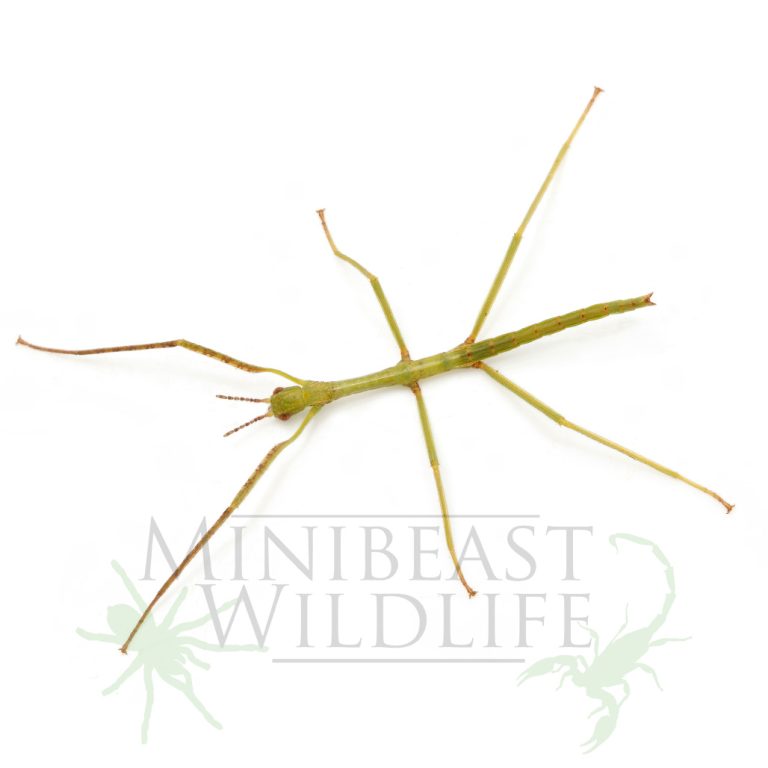
Giant Northern Stick Insects are among the most imposing of Australia’s stick insect fauna. They are very large slender-bodied insects and really impressive animals. The thorax (the body segment behind the head) is covered with an array of small spiny knobs, and they have large jagged serrations on the front legs.
Like most phasmids, the females grow much bigger and more heavily built than the males. Both sexes have wings when mature, however the females cannot fly due to their large size and body weight. Both sexes use their large fan-like wings to startle predators, and the males can fly quite well over short distances.
A great pet. These insects make amazing pets and are quite easy to keep.



Distribution and habitat
Acrophylla wuelfingi is found in far north Queensland in forest areas along the east coast. They can be found in a wide variety of habitats ranging from rainforest, eucalypt bushland and even She-oak woodlands (Allocasuarina spp.). They are regular visitors to suburban gardens in north Queensland, and males are often attracted to lights at night.
Behaviour
Giant Northern Stick Insects spend most of the time hanging motionless within foliage. They tend to hang beneath the foliage rather than sit on top, particularly as they grow larger. They move and feed periodically, usually adopting a swaying motion when they do. When threatened, they flare up their large wings as a threat display. This sudden change in size and form can startle predators enough to prevent an attack.
Size
While not the longest phasmids in Australia, this species grows to a considerable size. Adult males grow to 90–150 mm, and the large females mature at 180–230 mm in body length (not including outstretched legs).
Diet
Giant Northern Stick Insects feed on a wide variety of plants, including Gums (Eucalyptus spp.), Wattles (Acacia spp.), Cadagi (Corymbia torelliana), Paperbarks (Melaleuca spp.), Bottlebrush (Callistemon spp.), Brush Cherry/Lilly Pilly (Syzygium australe), She-oaks (Casuarina and Allocasuarina spp.) and even introduced trees such as Guava (Psidium spp.).
Keeping Giant Northern Stick Insects as pets
These insects make amazing pets and are quite easy to keep. Like all phasmids (stick and leaf insects), they need fresh foliage to feed on.
Visit our Breeding Room to see when we have them available, and check out our Care Guide for more information about their care.
Food plants
Provide fresh foliage as either cut stems of plants in a vase-style set up, or as live potted plants.
Young nymphs
Young nymphs can be kept in a compact enclosure such as our small pop-up mesh enclosures.
Growing adults
As they grow larger they need more space to moult their exoskeleton successfully. Our larger pop-up mesh enclosures are ideal for this.
Sharing an enclosure
They can be kept with other species of stick and leaf insects, as long as they are not overcrowded and their food requirements are met.