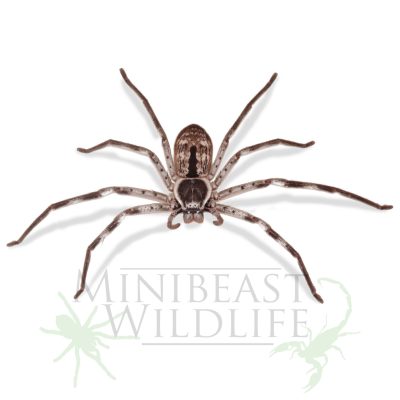
- Size: leg span up to 160 mm
- Habitat: east coast, Victoria to Queensland
- Diet: moths, crickets and cockroaches
Giant Banded Huntsman
Holconia immanis
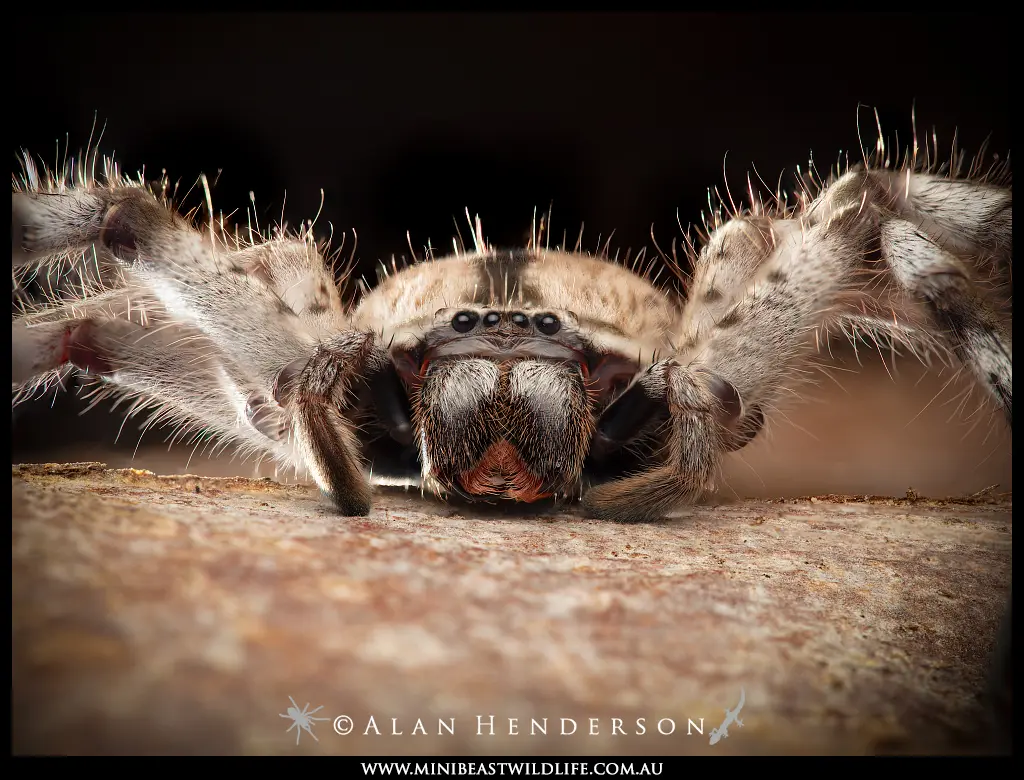
Giant Banded Huntsmen (Holconia immanis) are one of Australia’s largest spiders, growing up to a body length of 45 mm and a leg span of 160 mm. They are found along the coast of eastern Australia, ranging from Victoria to Queensland. The genus Holconia includes several very similar species found throughout other regions of Australia.
These spiders are extremely fast, and have the ability to run sideways and squeeze into very narrow crevices. They are covered in fine sensory hairs which are extremely sensitive to air movement, helping them detect prey and the approach of predators.
Captive bred. Our Giant Banded Huntsmen are captive bred, and should never be released into the wild.
Distribution and habitat
Giant Banded Huntsmen are found along the coast of eastern Australia, ranging from Victoria to Queensland. They usually shelter in dark places such as under loose tree bark.
Behaviour
Females lay their eggs in a flattened white silk egg sac, usually secured under loose bark, and stay with them until they hatch. Several hundred spiderlings may emerge 30–60 days later. They cluster around their mother for several weeks and tolerate each other at this stage, but once they disperse, chance meetings between siblings often end with one eating the other.
Size
One of Australia's largest spiders, growing up to a body length of 45 mm and a leg span of 160 mm. As they mature, males develop enlarged bulbs on the ends of their pedipalps (feelers), and tend to have thinner bodies and longer legs than females.
Diet
Giant Banded Huntsmen feed on a wide range of other invertebrates, including moths, crickets, cockroaches and other spiders. In the wild they have also been known to eat small vertebrates such as frogs and geckos.
Keeping Giant Banded Huntsmen as pets
Giant Banded Huntsmen live for 2–3 years. Due to their flattened bodies and speed, they are excellent escape artists, so make sure there are no gaps around the lid or doors of your enclosure, and take care when opening it.
Visit our Breeding Room to see when we have them available, and check out our Care Guide for more information about their care.
Housing
Use an enclosure that is taller than it is wide, as they like to climb upwards, and large enough to moult properly. Our pop-up mesh enclosures or Nano Habitat are ideal. Add flat bark set vertically or diagonally to climb on and hide behind. Substrate is optional. Ventilate well with no gaps, and keep out of direct sunlight.
Temperature and humidity
This species does best at 24–28°C, but will tolerate 16–24°C with a slower growth rate. Keep humidity at 40–60%, and mist spray lightly around your spider every second day so it can drink the droplets.
Feeding
Offer live insects such as crickets, cockroaches, moths and flies, no larger than a third of your spider's size. Feed twice a week (more often for growing spiders), and remove any uneaten insects after 12 hours.
Handling
Direct handling is not recommended. They are not dangerously venomous and are quite timid, but adults have large fangs and can give a painful bite. To move one, guide it into a jar or plastic container.