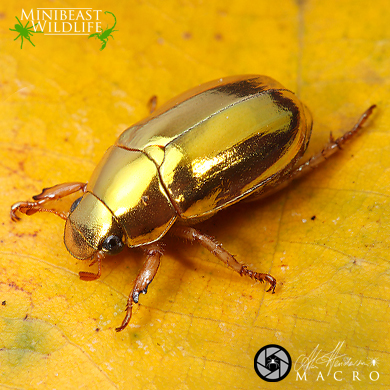

Few Australian insects look as though they were made by a jeweller. Each summer, as the heat builds and storms roll across the tropical north, a small beetle that looks like it has been dipped in molten gold takes to the air. The Golden Christmas Beetle is one of the most beautiful of our Christmas beetles, and also one of the least often seen.
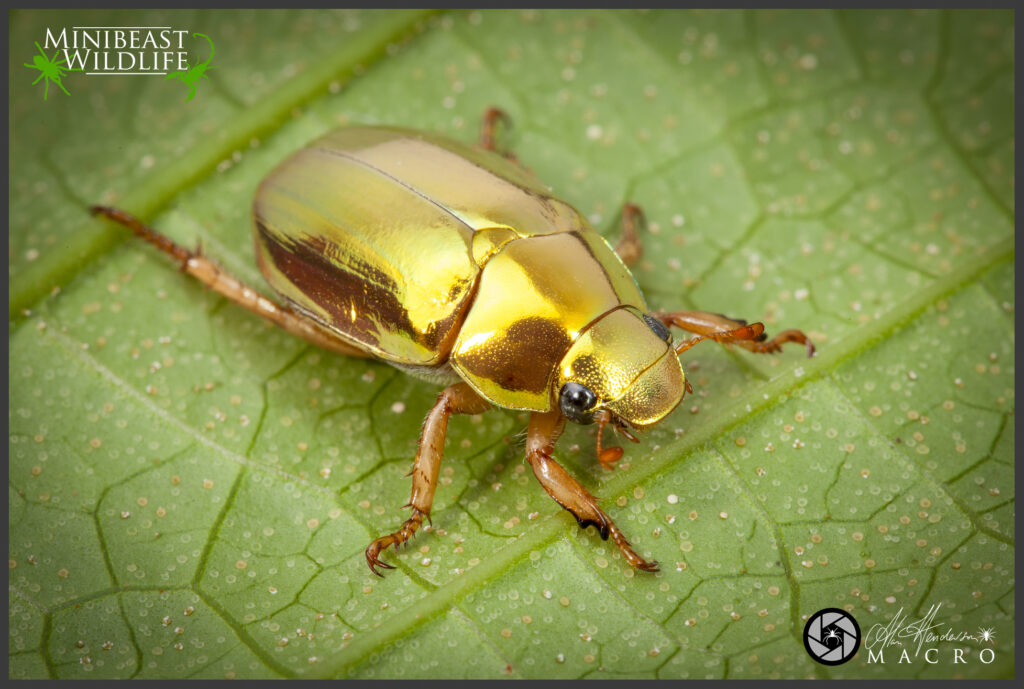
The Golden Christmas Beetle, Anoplognathus aureus, belongs to the scarab family of beetles, and to Anoplognathus, the genus that includes most of Australia’s well-known Christmas beetles. English entomologist Charles Owen Waterhouse described it in 1889, giving it the Latin name aureus, meaning “golden” – a fitting name.
This is a small Christmas beetle. Adults are usually 12 to 17 mm long, with females a little larger than males. Most individuals are a gleaming metallic golden yellow-green, from the top of the head to the tip of the wing covers. The underside is also metallic gold, and the legs are light reddish-brown. A less common colour form is a glossy coppery red-brown with a golden sheen underneath. These red individuals looked so different that one was once described as a separate species, before entomologists realised they were simply a colour variant of the same beetle.
The golden shine has nothing to do with pigment. It is a structural colour, produced by microscopically thin, layered structures in the beetle’s outer cuticle. These layers reflect light in a way that creates the mirror-like metallic finish. Scientists have studied the structural colours of Christmas beetles because of the way they reflect light, and they are among the most striking examples of this phenomenon in the insect world.
The Golden Christmas Beetle lives in tropical northern Australia. Most records come from the coast and ranges of north and central eastern Queensland, from around Cape York south to the Rockhampton region, including the Cairns, Mossman, Innisfail and Atherton Tableland areas. There are also records from further west across the north, including Broome in Western Australia. Even within its range it is not commonly encountered, which makes it a prized find for naturalists, photographers and beetle collectors.
Its popularity recently peaked, being voted the 2026 ABC Australian Insect of the Year. The little golden gem received thousands of votes in the annual event aimed to raising awareness of Australian invertebrates.
While it is very distinctive, it can be easily confused with its close relative, the more widespread Anoplognathus parvulus, which is also a gold to green-gold colour. The Golden Christmas Beetle is usually smaller and a yellower gold. Telling the two apart with confidence often means looking at fine details underneath the beetle, such as the shape of a spine-like projection between the legs, which is long and pointed in A. aureus and short and rounded in A. parvulus.
Like other Christmas beetles, the Golden Christmas Beetle spends most of its life hidden underground as a larva. Eggs are laid in the soil, and the larvae that hatch are the typical C-shaped, cream-coloured grubs of scarab beetles, often called curl grubs. They feed on plant roots and decaying organic matter, slowly growing over many months before pupating in a chamber in the soil. The adults emerge during the warm, wet months of late spring and summer, often triggered by rain softening the soil after a period of warm weather. They are strong flyers, active at dusk and through the night, and are frequently attracted to lights.
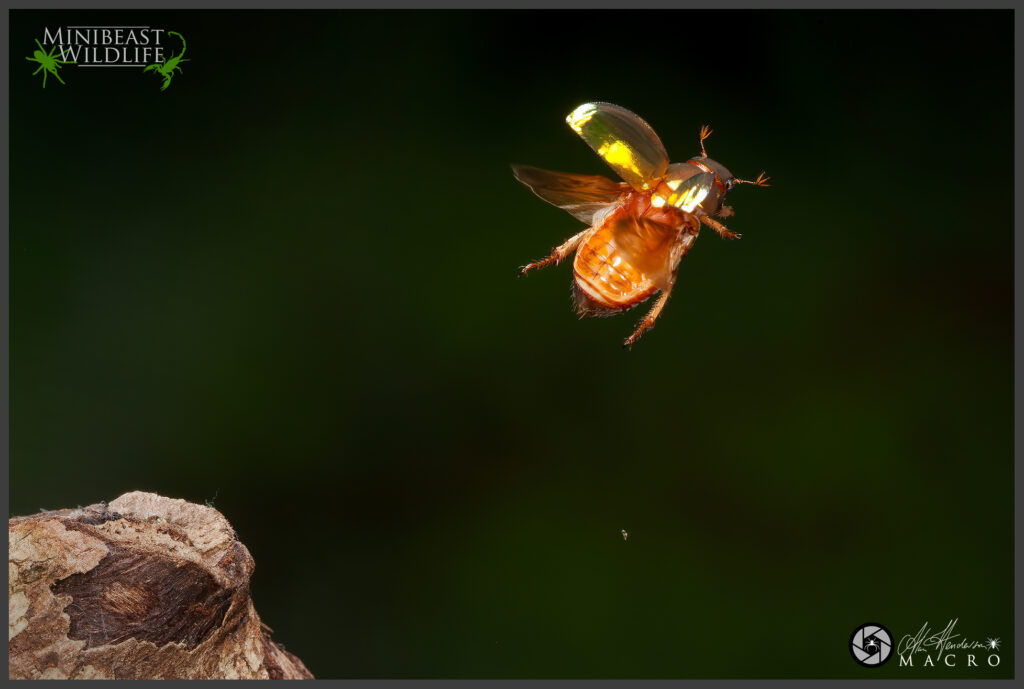
Most Christmas beetles are well known for feeding on eucalypt leaves, but the Golden Christmas Beetle has a broader taste. Adults have been recorded feeding on the leaves of a range of plants, including Cottonwood Hibiscus (Hibiscus tiliaceus), a common tree of tropical coastlines and creek banks, and Breynia (Breynia cernua). There are also reports of the beetle feeding on sugarcane on the Atherton Tableland. Like their relatives, adults chew leaves with strong mandibles, and several beetles may gather on a single plant to feed and find mates.
Christmas beetles were once so abundant across eastern Australia that they would weigh down the branches of trees. In many areas their numbers have declined, likely due to habitat loss, urbanisation and changes to the soils and grasslands their larvae depend on. Species that are naturally uncommon, like the Golden Christmas Beetle, are a reminder of how much of Australia’s insect diversity still goes unnoticed. If you are lucky enough to spot one of these shining beetles this summer, take a photo and record your sighting on a citizen science platform such as iNaturalist or the Atlas of Living Australia.